What Is the Best PVC Door Making Machine in China?

Choosing the best Pvc Door Making Machine in China starts with the finished profile, not the catalogue. A machine may look impressive under showroom lights. What matters is whether it produces straight, consistent door profiles during a full production shift.

The market context is substantial. Grand View Research estimated the global PVC market at about US$67.3 billion in 2023 and forecast growth through 2030. That figure describes PVC materials, not door-making machines. Still, it signals why buyers should examine how equipment handles material flow, heating, calibration, and cooling. The European Council of Vinyl Manufacturers also publishes guidance on PVC applications and processing, offering useful background beyond supplier claims.

Measure the details. Ask for sample profiles made with your intended formulation. Inspect corners, surface finish, and dimensional consistency. Check the extruder, die, calibration table, haul-off, and cutting system as one production line. A fast extruder cannot compensate for unstable calibration.

Manufacturing-quality expert W. Edwards Deming is often quoted: “In God we trust; all others must bring data.” Deming was not a PVC door-machine specialist, so this is a measurement principle, not a sector endorsement. Apply it by requesting documented output rates, energy use, changeover time, and service response. Then verify those figures with a production trial. One limitation remains: reported output can vary with profile design and material formulation. A careful buyer should allow for that variation. The best machine is the one that meets your own tested requirements.
What Is the Best PVC Door Making Machine in China?

What Is a PVC Door Making Machine?

A PVC door making machine is not usually one machine. It is a set of equipment that cuts, mills, joins, and assembles PVC components into a door. The exact line depends on the design: some doors use welded PVC profiles around an infill panel, while others are made from PVC foam boards. A typical profile-based setup includes a precision saw, end-milling unit, welding station, and corner-cleaning machine. Small details matter. A blade that cuts slightly off-square can leave visible gaps at the frame corners.

The process starts with measuring and cutting profiles to the required dimensions. Operators then mill drainage slots or hardware openings, weld the frame joints, and clean excess material from the corners. Panel-based doors may need routing and edge finishing instead. PlasticsEurope’s Plastics—the Fast Facts 2023 report states that PVC represented 10.2% of European plastics demand in 2022. This is broad material-market context, not a figure for door production or machine sales.

When assessing a machine, buyers should check its compatible profile or panel sizes, cutting accuracy, cycle time, and changeover requirements. Ask for a sample made from your actual material; catalogue speed alone can be misleading. I would also inspect the finished corners and test repeated cuts. A clean showroom sample is not enough. The weak point may only appear after several hours of operation.

How Does a PVC Door Making Machine Work?

What Is the Best PVC Door Making Machine in China?

How Does a PVC Door Making Machine Work?

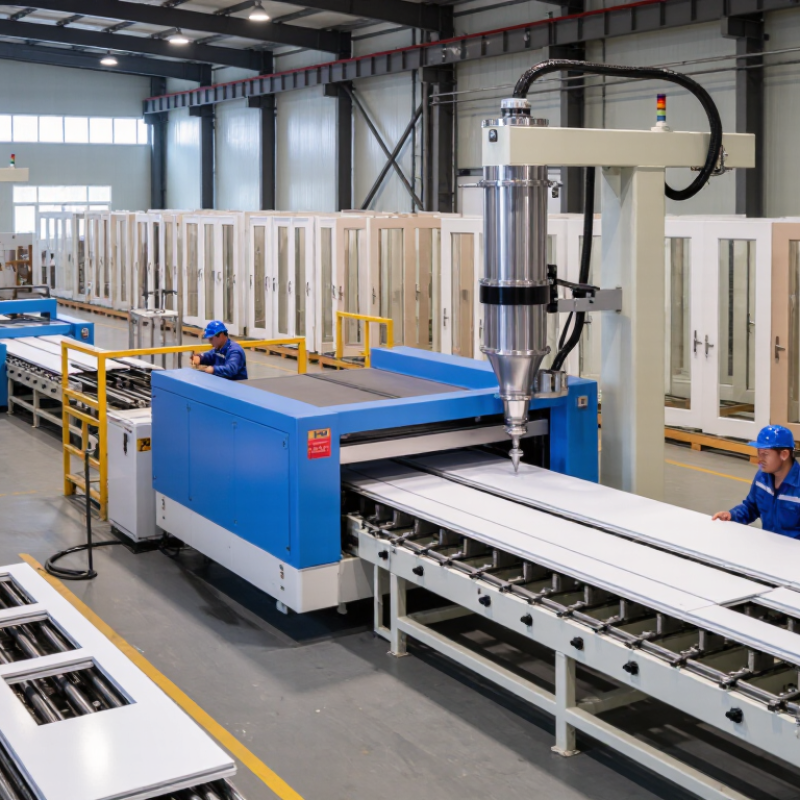
A PVC door machine is usually a set of linked stations, not one all-purpose unit. The exact setup depends on whether the door uses PVC profiles, foam boards, or both. In a profile line, material is heated and shaped through a die, then vacuum-calibrated and cooled. A haul-off unit pulls the profile forward, and a saw cuts it to length. Keep the cooling tank clean. Small deposits can affect the profile’s finish.

For foam-board doors, operators cut and mill the panel, apply a surface film or edge material, then assemble the frame and hardware. Sensors and adjustable guides help control dimensions, but setup still matters. A slight temperature change can alter a panel’s surface or make an edge bond less consistent. That detail is easy to miss.

Grand View Research valued the global PVC market at USD 66.2 billion in 2023, showing the material’s wide industrial use. That figure describes the material market, not door-machine sales. Buyers should compare a machine’s output with their own door dimensions, materials, and daily production target. Check sample cuts and finished corners before committing. A fast line is not always a better line.

What Is the Best PVC Door Making Machine in China? - How Does a PVC Door Making Machine Work?
Production stage Machine or equipment How it works Typical output or process result What to check when selecting equipment
Material preparation Batch mixer or material blending system Blends PVC resin with stabilizers, processing aids, pigments, and other formulation ingredients. The recipe depends on the intended product and the extrusion process. A consistent dry blend or prepared compound for the next production step. Confirm batch capacity, mixing control, dust management, and compatibility with the selected PVC formulation.
Profile production PVC profile extrusion line A heated screw plasticizes the PVC compound and pushes it through a die. The profile is then calibrated, cooled, pulled, and cut to length. Door-frame, sash, or other specified PVC profiles. Profile dimensions and shape depend on the die and calibration tooling. Match the extruder, die, calibration system, and haul-off to the required profile design, material formulation, and planned production rate.
Profile sizing and preparation Cutting saw and profile processing equipment Profiles are cut to the lengths and angles required by the door design. Depending on the system, operators or processing machines may also create drainage, hardware, or assembly openings. Prepared frame and sash components ready for assembly. Check cutting accuracy, supported profile dimensions, angle capability, guarding, and whether processing steps are manual or automated.
Frame and sash assembly Corner-welding machine and corner-cleaning equipment For compatible weldable profiles, a welding machine heats and joins the cut corners under controlled pressure. Excess weld material can then be removed using cleaning equipment. Joined frame or sash corners. The required welding method depends on the profile design and product specification. Verify that the machine supports the actual profile shape, number of welding heads, corner geometry, and required joint quality.
Door-leaf machining Panel saw, CNC router, or dedicated drilling and routing equipment Equipment cuts or machines door panels and components to drawing dimensions and creates openings for locks, handles, hinges, or other fittings where required. Machined door panels or components with specified dimensions and hardware openings. Compare working area, dimensional accuracy, tooling options, control system, and the complexity of the door designs to be produced.
Door assembly Assembly bench, fastening tools, and hardware installation equipment The prepared frame, panel, reinforcement, seals, and hardware are assembled according to the product design. The exact order and components vary by door construction. A completed door ready for inspection and adjustment. Check whether the equipment handles the intended door construction and sizes, and whether fixtures support repeatable alignment.
Inspection and finishing Inspection gauges and functional test fixtures Finished doors are checked for dimensions, appearance, smooth operation, and correct fitting of hardware. Testing requirements depend on the applicable product specification and market. Inspected doors with recorded quality results where required. Plan inspection criteria, measuring tools, traceability, and any testing required by relevant standards or customer specifications.
Choosing a suitable production line Complete line configuration matched to the door type A production line may combine material preparation, extrusion, cutting, profile assembly, panel machining, and door assembly. Not every PVC door uses the same materials or sequence. A configuration tailored to the selected product: for example, a profile-based uPVC door or a door made from PVC foam board. Define the door construction, materials, product range, target output, available floor space, staffing, utilities, tooling, service support, and operator training before comparing quotations.
Important: There is no single “best” machine for every PVC door. PVC profile doors and PVC foam-board doors can require different equipment and process routes. Machine specifications and production capacity should be confirmed against the exact product design, material, tooling, and supplier’s documented performance data.

What Types of PVC Door Making Machines Are Available in China?

In China, “PVC door making machine” can describe two different production routes: profile-based uPVC doors and foam-board door leaves. A profile line typically includes a conical twin-screw extruder, die, vacuum calibration table, haul-off, and cutter. Separate fabrication equipment saws profiles to length, welds frame corners, cleans weld seams, and cuts lock or hinge openings. Glazing-bead saws and assembly benches complete the workflow. That distinction matters. A profile line does not automatically produce a finished door.

Foam-board or WPC-style doors need a different setup: board extrusion or purchased boards, CNC routing, surface lamination, and edge finishing. Some factories add mixers and crushers for in-house material preparation, which increases space and dust-control requirements.

The National Bureau of Statistics of China reported 74.885 million tonnes of plastic-products output in its 2023 statistical data. This broad sector figure is not a PVC-door-machine market estimate, but it provides context for China’s plastics-processing base.

Match machine capacity to door thickness, daily output, profile dimensions, and changeover frequency. A detailed equipment list helps, though it cannot predict operator skill or actual scrap rates.

Which Features Determine the Best PVC Door Making Machine?

Choosing the best PVC door making machine in China depends on the profiles, output, and accuracy your workshop needs. A rigid frame helps limit vibration when cutting or routing long door components. That matters when a small shift can leave a visible gap at a corner. Check whether the machine holds profiles securely and supports repeatable positioning. Tiny details count.

Spindle power and tooling should match the PVC material and operations, not just the fastest production target. A higher speed is not automatically better. Ask how easily cutters can be changed, and whether common profile shapes can be handled without awkward manual adjustments. A practical trial with your own material can reveal rough edges, melting, or inconsistent cuts that a specification sheet may not show.

Controls should make settings clear and repeatable, especially when operators switch between door sizes. Look for accessible emergency stops, effective dust extraction, and guards that do not obstruct routine work. Also check setup time, maintenance access, and the availability of technical support and replacement parts. A machine with impressive capacity may still be a poor fit if your team spends hours changing fixtures. I would compare sample parts and operating costs before choosing; even careful testing cannot predict every production issue.

How to Evaluate Chinese Manufacturers and Machine Quality?

What Is the Best PVC Door Making Machine in China?

Evaluating Chinese manufacturers starts with the work your shop actually needs. Share your door profiles, expected daily output, and available floor space. Then ask for a machine configuration that matches those details, rather than a generic quotation. Compare cycle time, cutting accuracy, tooling, and electrical specifications across suppliers. A low price alone tells you little.

Request a live test using PVC profiles similar to yours. Watch the operator load a profile, adjust the settings, and complete a full cycle. Check cut edges, joint fit, noise, and visible vibration. Small flaws matter.

Ask for a written list of included components, spare parts, warranty terms, installation support, and training. Confirm who handles technical questions after delivery, and how quickly parts can be shipped. A polished showroom can still mislead; factory photos are not a substitute for a test. I would also speak with a recent customer, though one reference cannot prove consistent quality. Keep the comparison practical: record each machine’s tested output, accuracy, service response, and total operating costs.

Optimized by Optimole