
Why Are Bow Flags Ideal for Global Brand Promotion?
Bow Flags have become a practical visual tool for brands seeking attention across international markets. Their tall, curved silhouette remains visible above crowds, retail displays, and outdoor event equipment. A printed logo can move gently in the wind, creating motion without electricity or complicated installation. That simplicity helps businesses present a consistent identity in different countries.
Outdoor-display specialist David Richardson notes, “A strong flag does more than mark a location; it gives a brand a visible presence people can remember.” His observation reflects an important strength of Bow Flags. They combine portability, repeat exposure, and adaptable design in one promotional format. A hotel can place them beside its entrance. A sportswear company can line them along a race route. A trade-show team can use them to guide visitors toward a stand.
Their value is not automatic. Poor fabric, weak stitching, or unreadable lettering can reduce their impact quickly. Designers must consider local viewing distances, weather conditions, language, and cultural preferences. A bright design may attract attention in one setting, yet feel unsuitable in another. That limitation deserves attention.
When carefully produced, Bow Flags support recognizable branding without overwhelming the surrounding environment. They can be packed into compact cases, transported between campaigns, and reused at multiple locations. For global promotion, this balance of visibility and flexibility makes them a compelling choice. Sometimes, the simplest signal travels furthest.
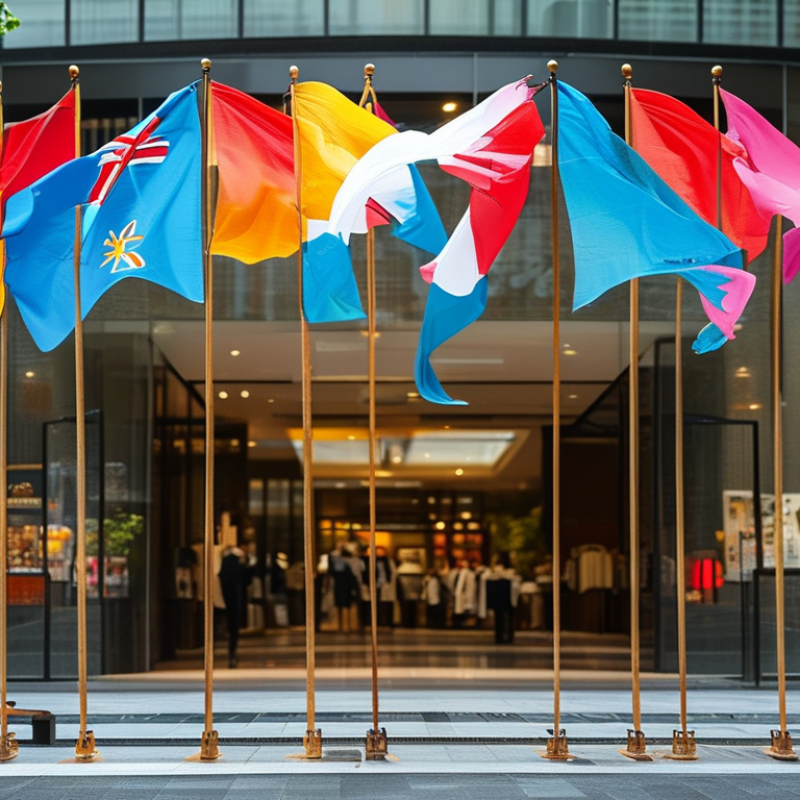
What Bow Flags Are and How They Work
Bow flags are curved, fabric display banners supported by flexible poles and a stable base. Their arched shape keeps the message visible from several viewing angles. Unlike rigid signs, the fabric moves gently with the wind, creating natural motion near entrances, roads, and event spaces.
The pole is usually assembled in sections and inserted into a sewn sleeve. As the pole bends, it stretches the fabric and forms the bow. A weighted base helps the flag remain upright, especially on busy outdoor sites.
In field setups, I have found that clear contrast and large lettering work better than crowded graphics. Visibility matters more than decoration. Still, wind conditions can change quickly, and no setup is perfect.
Tips: Use short wording that people can read while walking or driving slowly. Choose weather-resistant fabric and inspect the pole before each use. Match the base to the surface, such as grass, pavement, or indoor flooring. For global promotion, use simple symbols and review translations with native speakers. A phrase that feels natural in one market may sound awkward elsewhere. Check local display requirements before installation. Small mistakes are easy to miss, but they can weaken trust.

Key Features That Support Global Brand Visibility
Why Are Bow Flags Ideal for Global Brand Promotion?
Key Features That Support Global Brand Visibility
Bow flags combine mobility, clear messaging, and strong street-level visibility. Their curved fabric remains readable when wind changes direction, helping people recognize a message from several angles. In event planning, this matters near entrances, outdoor counters, and busy walkways. Visibility matters.
Lightweight poles make transport and setup practical across different markets. A compact carry bag can reduce storage problems during exhibitions, roadshows, and community events. Many systems use flexible fiberglass or aluminum sections, which support repeated assembly. The base can also be selected for grass, pavement, or indoor flooring. These details improve reliability, although one base rarely suits every location.
Consistent color reproduction supports global brand visibility across printed flags and digital campaigns. However, colors may appear different under sunlight, warehouse lighting, or camera exposure. Pre-production proofs are worth reviewing. Clear typography helps viewers understand the message quickly, especially when people are walking past. Short phrases work best. A washable, UV-resistant fabric can extend outdoor use, but no material remains perfect under constant weather exposure. Local wind limits, display permissions, and safety requirements should be checked before installation. This step is easy to overlook. That weakness deserves attention. With accurate artwork, durable construction, and location-sensitive planning, bow flags can provide a recognizable visual cue without requiring complex equipment.
Why Are Bow Flags Ideal for Global Brand Promotion?
Key Features That Support Global Brand Visibility
Bow flags are well suited to high-traffic promotional environments because they are portable, highly visible above pedestrian level, and easy to position at entrances, events, retail areas, and transport locations. The chart shows the scale of international visitor exposure available across major destination regions. Data are rounded estimates from the UN Tourism World Tourism Barometer, January 2024.
How Bow Flags Adapt to Different Markets and Events
Bow flags adapt to different markets because their message stays visible from several directions. Their curved fabric catches attention near entrances, roadsides, and crowded exhibition halls. From event setup experience, height and movement often matter more than complex graphics. Short wording works best. Visibility matters.
Market adaptation begins with local audience research. A symbol understood in one region may confuse visitors elsewhere. Colors can also carry different cultural meanings. Use clear icons, familiar language, and strong contrast. Translation should be checked by a fluent local reviewer, not copied automatically. Small errors damage trust quickly.
Material choices should match the local environment. Outdoor events may need UV-resistant fabric, reinforced stitching, and stable ground bases. Indoor venues usually require lighter bases and smaller flag sizes. Wind direction, rain, and uneven surfaces can change the setup plan. Not always.
At trade fairs, bow flags can guide visitors toward a display without blocking neighboring spaces. At sports events, they can mark entrances, information points, or temporary activity areas. Community events may need softer colors and less aggressive messaging. Reusable flag skins also reduce replacement costs and storage waste. However, one design cannot suit every event perfectly. A flag that looks sharp in bright sunlight may appear dull indoors. Testing it at the actual venue is often the wiser choice.
Designing Bow Flags for Clear, Cross-Cultural Messaging
Why Are Bow Flags Ideal for Global Brand Promotion?
Designing Bow Flags for Clear, Cross-Cultural Messaging
Bow flags work as moving visual landmarks at entrances, roadsides, and crowded events. Their tall shape keeps messages visible above people and nearby displays. DataReportal’s Digital 2024 Global Overview Report counted 5.35 billion internet users worldwide. Yet physical visibility still matters in places where attention is brief and digital access varies. A bow flag can deliver one symbol, one color system, and one action quickly.
Cross-cultural design requires restraint. CSA Research’s 2020 Can’t Read, Won’t Buy report found that 76% of online shoppers prefer product information in their own language. Use short, translated wording when language is necessary. Avoid idioms, complex humor, and gestures with uncertain meanings. Test colors carefully, because white, red, and yellow can carry different cultural signals. A clear icon often travels better than a clever slogan. Still, icons are not automatically universal. Our first design may look obvious to us and confusing elsewhere.
Tips: Keep the main message under five words. Place it at eye level when the flag bends. Use strong contrast and generous empty space. Ask local reviewers to test the design in real settings, not only on screens. Check readability from several distances. A perfect digital mockup can fail beside sunlight, wind, and moving crowds. Revisions are normal, and sometimes the simplest version communicates best.
Why Are Bow Flags Ideal for Global Brand Promotion? - Designing Bow Flags for Clear, Cross-Cultural Messaging
| Communication Dimension | Verified Cross-Cultural Fact | Bow Flag Design Recommendation | Practical Validation Measure | Reference |
|---|---|---|---|---|
| Writing direction | Latin-based scripts are generally written from left to right, while Arabic and Hebrew are written from right to left. | Keep the main message inside a central safe area and prepare separate layouts for left-to-right and right-to-left markets. Do not simply mirror logos or directional icons without review. | Review each localized layout with a fluent reader and test the flag from both walking directions. | Unicode Bidirectional Algorithm; W3C Internationalization |
| Message length | Shorter text is easier to scan on moving outdoor displays than dense paragraphs, especially when viewers have limited dwell time. | Use one primary promise or action phrase, supported by a simple symbol. Move detailed information to a website, QR landing page, or printed handout. | Conduct a three-second comprehension test: viewers should identify the subject and intended action without assistance. | Human-factors principle: recognition is faster when visual information is concise and hierarchical. |
| Color contrast | The WCAG 2.2 minimum contrast ratio is 4.5:1 for normal-sized text and 3:1 for large text. | Use high-contrast text and background combinations, and avoid placing fine lettering over gradients, photographs, or visually busy fabric patterns. | Check digital artwork with a contrast analyzer, then verify printed fabric under daylight and indoor lighting. | W3C Web Content Accessibility Guidelines (WCAG) 2.2, Success Criterion 1.4.3 |
| Color meaning | Color associations vary by culture, context, religion, and industry; no single color has a universal emotional meaning. | Use color primarily for contrast, recognition, and navigation. Validate sensitive color choices with local stakeholders instead of relying on generalized cultural color charts. | Ask representative local users whether the palette communicates the intended tone and whether any unintended associations arise. | Cross-cultural design research and local user validation practice |
| Typography | Typeface availability and character support differ across writing systems. A font that supports Latin characters may not support Arabic, Hebrew, or East Asian characters correctly. | Select a type family or coordinated font set with complete character coverage, clear letterforms, and sufficient weight for outdoor viewing. | Check every localized character for missing glyphs, incorrect shaping, spacing problems, and reduced legibility after fabric production. | Unicode Standard; W3C Internationalization |
| Icon and symbol use | Symbols are not interpreted identically in every culture, and some icons depend on region-specific conventions or metaphors. | Use simple, action-oriented icons with a short text label. Avoid gestures, hand signs, animals, or religious references unless locally reviewed. | Test icon recognition with users from each target market and record correct interpretation without verbal explanation. | ISO 3864 design principles for safety signs; local usability testing |
| Reading orientation | A bow flag can rotate, curve, and move in wind, so viewers may see the message from changing angles and distances. | Place the most important information in the visually stable central section. Avoid critical details near the curved edge, seam, or pole sleeve. | Inspect prototypes from front, side, near, and oblique viewpoints in both calm and windy conditions. | Outdoor wayfinding and visual-merchandising usability practice |
| Translation quality | Literal translation can change tone, word length, reading order, and cultural meaning. Some languages also require more or fewer characters to express the same idea. | Translate for meaning and context, not word-for-word equivalence. Allow flexible text areas and approve copy with native-speaking reviewers. | Use independent linguistic review and compare comprehension, tone, and call-to-action clarity across markets. | ISO 17100 translation-service principles; native-speaker review |
| Accessibility and inclusion | Color-vision differences, low vision, glare, and viewing distance can affect how outdoor messages are perceived. | Do not communicate meaning through color alone. Combine color with text, shape, position, or icons, and use generous spacing between elements. | Review the design in grayscale, under glare, and at reduced size; confirm that the core message remains identifiable. | WCAG 2.2; inclusive visual communication practice |
Practical Uses of Bow Flags in International Promotion
Why Are Bow Flags Ideal for Global Brand Promotion?
Bow flags offer a practical way to support international promotion in busy public spaces. Their curved fabric catches attention while remaining lightweight and easy to move. Event teams can place them near entrances, registration desks, product displays, or temporary information points. They also work well outside shops, exhibition halls, sports venues, and community events.
Their usefulness depends on clear planning. A short message is easier to read from several metres away. Simple symbols can support communication when visitors speak different languages. Choose durable fabric, stable bases, and weather-suitable materials for outdoor campaigns. Local event staff should test visibility before opening. A flag may appear impressive in a design file but look crowded in real conditions.
Tips:
Keep the main message under seven words. Use strong contrast and readable lettering. Position flags beside, not directly in front of, entrances. Check wind conditions and walking routes. Photograph the setup from a visitor’s viewpoint. Small adjustments often improve visibility.
Bow flags can also guide visitors through large venues. Matching colours may identify different service areas without adding excessive signage. Reusable flag systems can reduce storage pressure during repeated campaigns.
Still, they are not perfect. Poor placement can block movement, and overly bright designs may weaken visual comfort. Review local venue rules, accessibility needs, and cultural expectations before installation. Feedback from staff and visitors can reveal problems that planning misses.