
Who Are the Top WPC Hollow Decking Suppliers in China?

Choosing a WPC Hollow Decking supplier in China takes more than comparing prices. A board may look convincing in a showroom, yet perform differently after months of sun, rain, and foot traffic. Buyers should examine profile dimensions, surface texture, composition details, test reports, production capacity, and warranty terms. Ask for samples. Check the cut edge, too.

Dr. Michael P. Wolcott is a wood-composites researcher whose work concerns how material formulation and processing affect performance. A practical, non-verbatim takeaway aligned with that field is: “Assess the material and its evidence, not just its finish.” This is an editorial paraphrase, not a direct quotation from Wolcott. That distinction matters when a buyer’s guide aims to be trustworthy.

This guide compares Chinese suppliers through details that can be checked: product range, manufacturing transparency, quality documentation, customization, export experience, and after-sales support. A useful inquiry asks for a current datasheet and matching test records—not simply a polished catalog. Look closely at claims about slip resistance, moisture behavior, and color stability; methods and conditions can differ. One overlooked point is installation guidance. Even a well-made hollow board can disappoint if spacing, substructure, or drainage is poorly planned. No supplier comparison removes every uncertainty. But clear evidence makes the choice less dependent on sales language, and more grounded in the deck you actually need.
Who Are the Top WPC Hollow Decking Suppliers in China?

What Is WPC Hollow Decking?

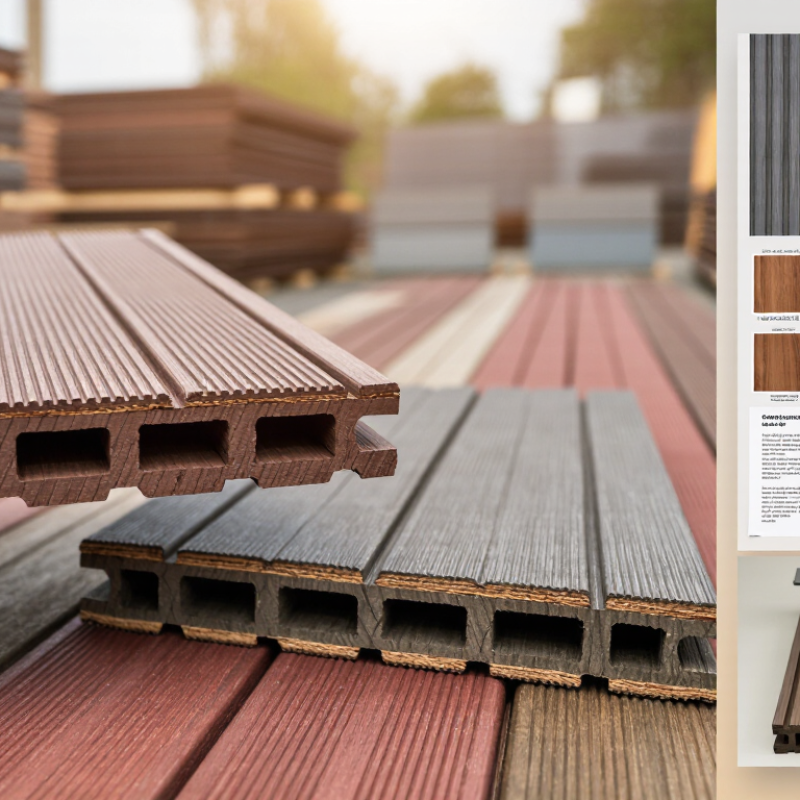
WPC hollow decking is an outdoor board made from wood fibers and thermoplastics, with lengthwise cavities inside its profile. The material aims to combine a wood-like appearance with lower routine upkeep than untreated timber. The hollow core reduces weight and material use, making boards easier to carry across a garden or balcony. It does not make every product equally durable. Formulas, wall thickness, surface texture, and manufacturing quality vary between suppliers.

Those internal channels are hidden once installed. They can make a board lighter, but strength still depends on its design and support spacing. A cut end may expose the cavities, so matching end caps can create a cleaner finish and limit debris entry. WPC can also expand or contract with temperature changes. Leave the clearances specified for the product, especially near walls and fixed edges. One detail is easy to overlook: a hollow board is not automatically suitable for every load or climate.

Tips: Ask suppliers for a section sample and installation guide. Check board thickness, joist spacing, fastening method, and care requirements. Compare samples in daylight; colors can look different outdoors. If the technical sheet is unclear, pause before ordering.

How Is WPC Hollow Decking Manufactured in China?

In China, hollow WPC decking is generally made by combining wood flour with thermoplastic resin and processing additives. The exact formulation varies by factory and intended use. Wood flour is dried before blending because excess moisture can cause bubbles, weak spots, or an uneven surface. Moisture matters. Operators then mix the ingredients until the compound has a consistent texture and color.

The prepared material enters an extruder, where heat and pressure soften it into a workable melt. A shaped die forms the decking profile, including its internal hollow chambers. Calibration equipment holds the shape as the profile cools, while a haul-off unit draws it forward at a controlled speed. Small changes in temperature or line speed can affect wall thickness and straightness. The boards are cut to length, and some receive brushed or embossed finishes for added texture.

Quality checks should cover more than appearance. Manufacturers may measure dimensions, inspect chamber walls, and test samples for bending strength and water absorption. Results can vary between production runs, so a single attractive sample is not enough evidence. Ask how the factory records batch checks and manages recycled feedstock. That part deserves a closer look. A tidy surface does not always reveal what is happening inside the profile.

Who Are the Top WPC Hollow Decking Suppliers in China? How Is WPC Hollow Decking Manufactured?

Typical WPC formulation ranges by component, shown as approximate weight percentages. These are general industry ranges, not supplier-specific figures; the ranges vary by product and are not intended to add up to 100%.

How it’s made: Manufacturers typically blend wood fiber or flour with thermoplastic and additives, then extrude the mixture through a hollow-profile die. The profile is calibrated and cooled before cutting and quality inspection. Exact formulations and production settings differ by product.

Who Are the Major WPC Hollow Decking Suppliers in China?

Who Are the Major WPC Hollow Decking Suppliers in China?

China’s major WPC hollow decking suppliers generally include manufacturers with their own extrusion lines, export-focused factories, and established building-material distributors. They differ in production capacity, profile designs, and support after delivery. Some specialize in lightweight boards for balconies, while others make thicker profiles for larger outdoor areas. A supplier’s size alone does not prove consistent quality.

Ask for a current product specification sheet and samples from the same production batch. Check the board’s weight, wall thickness, surface finish, and fit between connecting edges. Request test data for water absorption, weathering, and slip resistance, then confirm what those results cover. Factory photos can help, but an independent inspection gives a clearer view of production and packing. Samples can mislead. A small batch may not reveal color variation across a full order, so request a larger sample set when appearance matters.

Tips: Compare written warranties, lead times, and replacement procedures—not just unit prices. Clarify whether quoted dimensions are nominal or actual, and ask how the boards are stored before shipment. A careful supplier should answer specific questions without promising that the decking will never fade or deform. That restraint is useful.

How Do Chinese Suppliers Differ in Products and Services?

Chinese WPC hollow decking suppliers differ in profile design, surface finish, and the amount of product information they provide. Some offer lightweight hollow boards with narrow chambers; others use thicker walls for added stiffness. Surface options may include brushed grain, grooves, or a capped layer intended to resist stains and fading. Check the actual sample. A catalog photo cannot show how slippery a wet board feels or how evenly its color runs.

Product details matter. Ask for board dimensions, wall thickness, recommended joist spacing, and care instructions. Compare these details across quotations, not just the price per square meter. Small differences can affect installation and waste. They can also be easy to overlook.

Services vary too. Some suppliers can provide cut lengths, matching trims, loading plans, and installation guidance. Others mainly handle production and shipping. Confirm sample costs, minimum order quantities, lead times, packaging, and how damaged pieces are handled. Request test reports or warranty terms in writing, and check what conditions they cover. That is not always easy to judge from a sales conversation. A clear technical response is useful, but it does not replace checking samples and documents yourself.

Who Are the Top WPC Hollow Decking Suppliers in China? - How Do Chinese Suppliers Differ in Products and Services?

Supplier offerings vary, so the comparison below focuses on verifiable product and service attributes rather than naming or ranking individual companies. Confirm specifications and supporting documents directly with each supplier.

Comparison dimension Supplier differences to look for What to verify before ordering
Material formulation Products may use different wood-fiber and thermoplastic combinations. The polymer type and proportion can differ by product line. Request the product specification, declared material composition, and confirmation that the quoted formulation applies to the order.
Hollow profile design Profiles differ in overall dimensions, wall thickness, chamber layout, and edge shape. These details affect fit and installation compatibility. Get a dimensioned drawing and sample. Check joist spacing, fastening method, and compatible starter or finishing pieces.
Surface and colour options Available finishes can include brushed, embossed, or wood-grain textures, with colour ranges varying by collection and production batch. Review a physical sample and ask how colour variation, sample-to-production differences, and replacement matching are handled.
Uncapped or capped construction Some ranges have an exposed composite surface; others use a polymer-rich outer layer. Construction and claimed performance are product-specific. Confirm the construction in writing and request relevant test reports for claims such as stain resistance, water absorption, or weathering.
Performance documentation The availability and scope of test reports, technical data sheets, and installation guidance differ between suppliers and product lines. Check that reports identify the same product construction and test method as the decking being quoted; verify standards required for the destination market.
Accessories and system compatibility Suppliers may offer different matching clips, screws, fascia, and trims. Compatibility is not universal across profiles. Request an itemized bill of materials and confirm that the fasteners and accessories are designed for the selected board profile.
Customization and order terms Custom colours, lengths, packaging, and private-label services may be available, subject to supplier capability and order quantity. Obtain written confirmation of minimum order quantities, tooling or setup costs, production lead time, and packaging details.
Quality control and warranty Inspection procedures, batch traceability, defect handling, and warranty coverage differ by supplier and contract. Review the warranty terms, exclusions, claim process, inspection criteria, and pre-shipment inspection arrangements.
Export and after-sales support Export experience, shipping coordination, document support, and responsiveness after delivery can vary independently of product specifications. Confirm the trade terms, shipping documents, packing method, communication contact, and procedure for transit damage or product issues.

A reliable comparison uses matching product samples, written specifications, applicable test documentation, and clearly stated commercial terms—not supplier claims alone.

What Factors Should Buyers Consider When Choosing a Supplier?

A reliable WPC hollow decking supplier should explain its board composition, manufacturing tolerances, and quality checks in clear terms. Ask how the product handles moisture, sunlight, and temperature changes. Request current test reports, and check that they match the exact board profile you plan to order. Keep the paperwork.

Review the warranty carefully. Note what it covers, how long it lasts, and which installation conditions may void it. Ask for a sample large enough to inspect the surface, color consistency, and hollow-core finish. A small cut piece can hide variation across a full-length board. Compare stated dimensions with measurements from several samples, not just one.

Check production capacity, lead times, packaging, and export experience before placing a large order. Clear answers matter, especially when a delivery delay could disrupt installation. Ask whether the supplier can provide installation guidance and replacement boards for damaged shipments. A polished catalog alone proves little. Even with careful checks, batches may differ slightly, so confirm acceptable color variation and inspection procedures in writing. Choosing a supplier is partly a judgment call; no checklist removes every uncertainty.

Optimized by Optimole