Top Patterned Children Play Mat Suppliers for 2026?
Choosing a Patterned Children Play Mat supplier for 2026 involves more than comparing colorful designs. Buyers need to assess materials, print quality, cushioning, surface grip, and ease of cleaning. A cheerful animal print may look appealing online, but samples reveal details that photos can hide: uneven edges, strong odors, or patterns that fade after wiping. Small details matter.
This guide introduces suppliers and practical checks for comparing their products. It considers product range, customization options, sample access, minimum order quantities, production capacity, and communication. Reliable suppliers should provide clear product specifications and relevant testing documents for review. Buyers should confirm that documents match the exact mat model, rather than relying on broad claims. A polished website alone is not evidence of consistent manufacturing.
There is no single supplier that suits every retailer or project. A nursery buyer may value soft cushioning and simple cleaning, while a distributor may focus on repeatable colors and dependable delivery estimates. Ask how the mat performs on common floor surfaces, how its print holds up, and what happens if a production batch differs from the approved sample. Some answers may remain imperfect; that is worth noting, not ignoring. Careful comparison helps buyers choose with clearer expectations and fewer surprises.
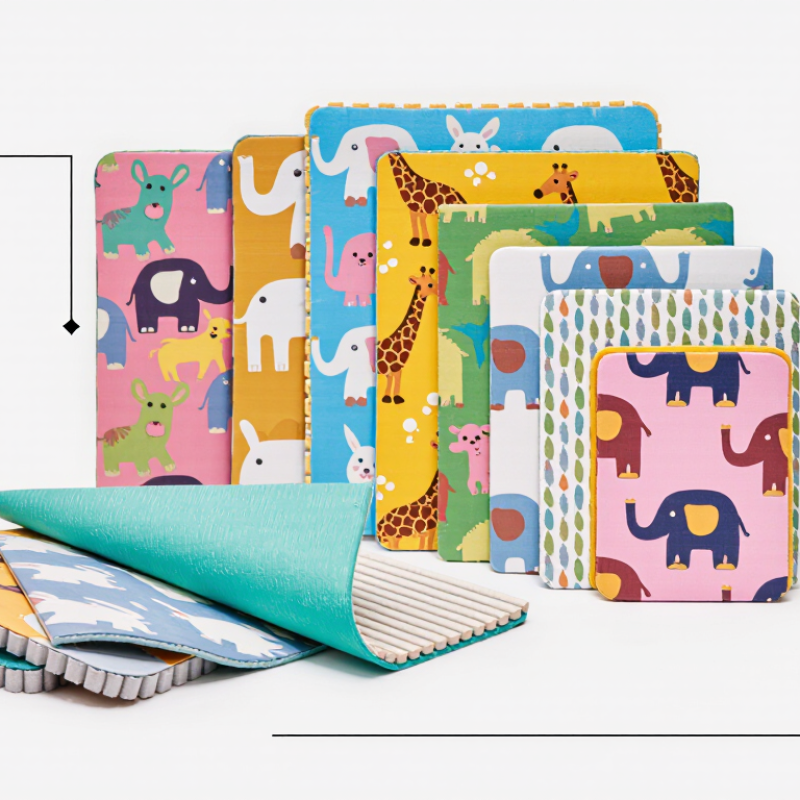
Understanding Patterned Children’s Play Mats and Their Uses
Patterned children’s play mats add color while giving play a defined place. Roads, letter grids, animals, and simple shapes can inspire pretend games or early matching activities. A child might push a toy car along a printed route, then use the same mat for blocks. Keep it simple. Patterns can support play, but they do not replace adult interaction or age-appropriate toys.
At home, check the mat’s size, thickness, surface feel, and cleaning instructions. Make sure it lies flat on the intended floor; curled edges can become a tripping concern. Check product details for age guidance and material information, especially if the mat will be used by a young child. A bright print may look appealing online, yet colors and texture can appear different in person. Not every pattern suits every room.
When comparing suppliers, ask for clear product specifications, close-up images, and care guidance. Request details about the backing and how the mat is tested for everyday use. Where possible, review a sample under your room’s lighting and on your actual flooring. Small details matter: printed lines should be easy to see, and the surface should feel comfortable during floor play. One limitation is worth noting: busy graphics can distract some children, so a quieter design may work better for focused activities.
Key Standards for Evaluating Play Mat Suppliers
Top Patterned Children Play Mat Suppliers for 2026?
Key Standards for Evaluating Play Mat Suppliers
A reliable supplier should provide clear, current test records for the exact mat materials. Check the foam, backing, printed inks, and production lot—not just a similar sample. Ask whether testing covers relevant toy-safety and chemical requirements, including ASTM F963 where applicable. Independent laboratory reports are more useful than a general “safe materials” claim. Small details matter.
Review construction as carefully as paperwork. Request measurements for thickness, dimensions, and surface durability, then compare them with a physical sample. Ask how the supplier controls pattern alignment, edge finishing, and batch consistency.
WHO’s 2021 Falls fact sheet estimates that 37.3 million falls each year require medical attention worldwide, across all ages. This is not play-mat injury data, but it underscores why stable placement and clear care instructions deserve attention.
A checklist can still miss real-use problems, so test samples on the floors and in the rooms where families will use them.
Tips: Ask for raw test reports, batch traceability, and a written process for handling defects. Check sample edges and seams by hand. If answers are vague, pause and ask again.
Supplier Profiles and Product Specialties for 2026
Supplier profiles for patterned children’s play mats often fall into three groups: printed foam converters, textile-and-padding makers, and modular tile producers. Foam specialists offer bright, wipe-clean surfaces and custom shapes; textile suppliers focus on stitched edges and softer, foldable designs. Tile makers suit play areas that need flexible sizing. Pattern quality matters, but so do print rub resistance, edge finish, thickness consistency, and clear material specifications.
Circana’s 2023 U.S. toy industry review estimated toy sales at $28.3 billion, down 8% year over year. That pressure makes durable, clearly differentiated products commercially relevant. Safety deserves equal attention: the U.S. Consumer Product Safety Commission estimated 231,700 toy-related emergency-room injuries in 2023. This figure covers toys broadly, not play mats specifically. Buyers should request product-level test documentation, batch traceability, and care instructions rather than treating a supplier’s general certificate as proof for every design.
A useful supplier profile should name its specialty, customization limits, minimum order quantity, and quality checks. Ask how printed colors are checked after abrasion, and how foam edges are inspected for peeling. Small details count. Still, supplier claims are not always easy to compare; test methods and sample conditions may differ. A pre-production sample can reveal uneven seams, strong odors, or a pattern that looks less crisp than its digital proof.
Top Patterned Children’s Play Mat Suppliers for 2026
Supplier Profiles and Product Specialties: a U.S. chemical-safety benchmark for evaluating children’s play mats
How to read this: The chart shows regulatory limits, not supplier scores, test results, or market shares. U.S. law limits lead in accessible components of covered children’s products to 100 ppm. For covered toys and child-care articles, each restricted phthalate is limited to 0.1% (1,000 ppm). Applicability depends on the product and component; request current, product-specific test documentation from suppliers.
Sources: U.S. Consumer Product Safety Commission, CPSIA lead requirements and phthalates requirements (Section 108).
Comparing Materials, Patterns, Safety, and Customization
Choosing a patterned children’s play mat supplier means looking beyond attractive product photos. Ask what each mat is made from, how thick it is, and whether its surface feels firm or cushioned underfoot. Foam, fabric, and layered constructions can differ in cleaning needs and durability. Request material details and care instructions in writing. Check seams, edges, and the underside for loose layers or a finish that slides on your floor. Small details matter.
Patterns should suit both the room and the child’s play. High-contrast roads, animals, or simple geometric shapes are easy to notice, while crowded prints can make small toys harder to spot. Ask suppliers for color samples, since screens often distort shades. Not perfect, but useful. For safety, review applicable test reports, age guidance, and warnings for the specific product rather than relying on general claims. Also ask how printed surfaces hold up after repeated wiping.
Customization can include dimensions, colors, artwork, and packaging, but each option may affect lead time and minimum order quantities. Request a physical sample before approving a large run. Check whether the print stays aligned near seams and whether the mat matches the promised thickness. A supplier’s response to these questions can reveal how carefully it handles quality checks. I would still leave room for a little uncertainty: samples show one unit, not every unit in production.
How to Select and Source a Suitable Play Mat Supplier
Top Patterned Children Play Mat Suppliers for 2026?
Choosing a patterned children’s play mat supplier starts with intended use, not the printed design. A nursery mat may need a softer surface, while a daycare floor needs durable edges and easy cleaning. Ask for the full material specification, thickness, surface finish, and backing details. Request a sample in the actual colorway. Small prints can look crisp online, then blur or shift on a larger mat. Ask for evidence.
Check how the supplier controls repeat orders. Request written tolerances for dimensions, color variation, and print alignment, plus dated photos from a recent production run. Ask whether batches are checked for odors, surface defects, and peeling edges. A sample is useful, but it cannot guarantee every carton will match. Confirm carton counts, protective packaging, production lead time, and how damaged goods are handled. Ask for relevant test documentation for your intended market.
Compare more than unit price. Clarify minimum order quantities, sample charges, payment milestones, and reorder terms before committing. Test the mat on a hard floor; wipe it with a cleaner families might use, then check its grip and print. Patterns matter. I would not treat a polished catalog as proof; it is only a starting point. One detail is easy to miss: ask who approves color changes when a production batch shifts. That answer can reveal how carefully the supplier manages quality.