
China Top 10 Spray Painting 3D Printed Parts Suppliers?
Finding a dependable partner for Spray Painting 3d Printed Parts takes more than comparing prices or browsing polished product photos. Printed surfaces can show layer lines, tiny pits, or uneven edges, and paint may reveal every one. A capable supplier should explain how parts are cleaned, sanded, primed, coated, and inspected. The details matter.
This guide introduces ten China-based suppliers serving customers who need painted prototypes, display models, housings, or small production runs. It is a starting point, not a laboratory-certified ranking. Supplier capabilities, equipment, and lead times can change, so confirm current details directly before placing an order. Ask whether a sample part can be finished using your actual material and geometry. That small test can expose adhesion problems or color differences before a larger batch is made.
Look beyond the final color. Ask about surface preparation, coating options, dimensional tolerances, masking, and how defects are handled. A glossy finish may look excellent under showroom lights but show scratches in daily use. Matte coatings can hide some marks, though they may not suit every design. There is no universal best finish. Share a drawing, reference color, and expected use, then request clear inspection criteria and written delivery terms. Some comparisons remain difficult without samples; supplier descriptions alone rarely tell the whole story. A careful conversation, backed by physical evidence, is usually more useful than a perfect-looking catalog.
How Spray Painting Enhances 3D Printed Parts
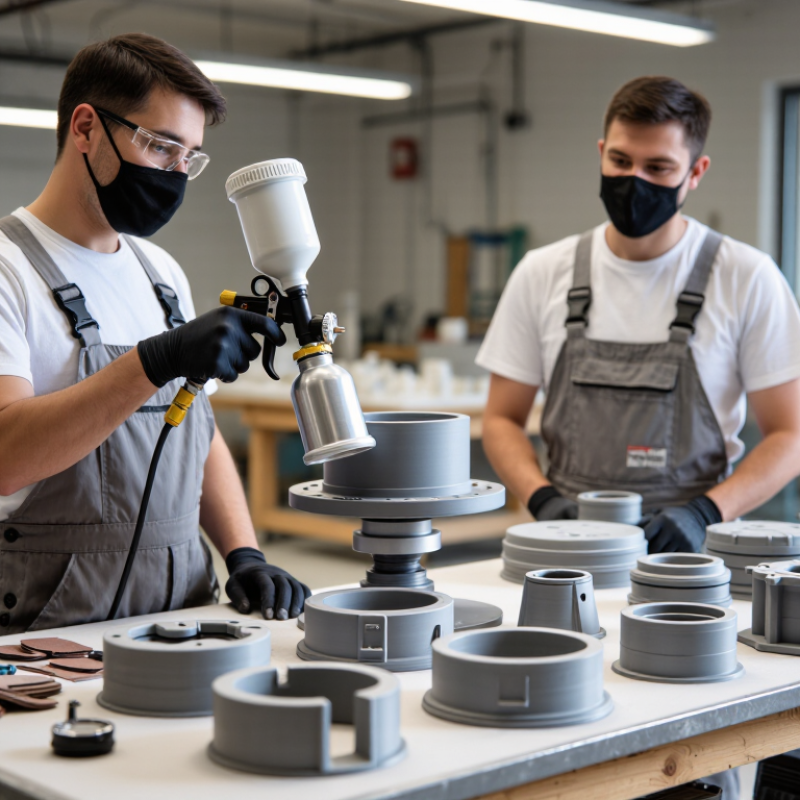
Spray painting can make 3D-printed parts look more uniform, but its value goes beyond color. A thin, even coat softens the visual effect of layer lines and helps prototypes fit more naturally into product demonstrations.
Wohlers Report 2024 estimated that global additive manufacturing industry revenue reached $20.035 billion in 2023, an 11.1% rise from 2022. That growth makes reliable finishing more relevant, though the figure measures the industry—not demand for spray painting specifically.
Good results depend on preparation. Remove loose dust, sand visible ridges, and apply a primer compatible with the print material. Use light passes rather than one heavy coat; paint can pool around holes, soften sharp edges, or hide fine texture. Mask threads and mating surfaces. Let each layer cure fully.
Small details matter. Grand View Research valued the global 3D-printing market at $20.37 billion in 2023 and forecast a 23.5% compound annual growth rate through 2030. Those estimates use a different market scope from Wohlers’ report, so they should not be compared directly.
A hidden-area test is still wise. It may feel slow, and the finish can remain imperfect, especially on complex prints.
Key Criteria for Choosing a Chinese Spray Painting Supplier
A capable Chinese spray painting supplier should understand how 3D printed materials behave, not just how to apply color. Resin, nylon, and printed plastics can react differently to primers and solvents. Ask how the team checks adhesion on your specific material. Request a sample made from the same print process, not a smooth display coupon. Small details matter.
Look closely at surface preparation. Ask whether sanding, filling, cleaning, and priming are included, and how the supplier controls dust between steps. For parts with holes or moving joints, confirm how areas are masked. Paint can change fit. A sample should show the actual color, gloss, texture, and edge coverage under ordinary lighting. Ask for inspection records and agreed acceptance limits. Ask for proof.
Production consistency needs equal attention. Compare a first article with later pieces, and ask how color is measured across batches. Clarify curing time, packaging, lead time, and what happens when a part fails inspection. A low quote may exclude preparation or careful masking; request a cost breakdown. Communication also counts: clear answers about defects are more useful than confident promises. I would still test a small batch before committing. That extra step can reveal issues the sample missed.
China Top 10 Spray Painting 3D Printed Parts Suppliers? — Key Criteria for Choosing a Chinese Spray Painting Supplier
Supplier-neutral evaluation checklist, not a verified ranking of specific companies. Ask shortlisted suppliers for current, part-specific evidence; requirements vary by material, coating system, part geometry, and destination market.
| No. | Evaluation criterion | What to confirm | Useful evidence or test | Why it matters |
|---|---|---|---|---|
| 1 | 3D-printing material experience | Confirm experience with the specific substrate, such as SLA resin, SLS nylon, or FDM thermoplastic. Ask how the supplier checks compatibility before coating. | Material-specific sample parts, documented coating process, and a trial on the same print material and finish. | Different plastics and resins can react differently to cleaners, primers, solvents, and curing conditions. |
| 2 | Surface preparation | Ask how the supplier removes support marks, powder, oils, and visible layer lines, and how preparation is controlled to avoid changing critical features. | Written preparation steps and an approved first-article sample showing the agreed surface finish. | Paint appearance and adhesion depend heavily on the condition and cleanliness of the substrate. |
| 3 | Primer and coating compatibility | Confirm the proposed primer, topcoat, and curing process are suitable for the printed material and the part’s intended use. | Coating technical data sheets, safety data sheets, and results from a part-specific coating trial. | An unsuitable coating system can cause poor adhesion, surface defects, or damage to the printed part. |
| 4 | Adhesion testing | Agree on the test method, acceptance criteria, test location, and whether testing will be performed on representative production parts or witness samples. | For applicable coatings and substrates, cross-cut methods include ISO 2409 or ASTM D3359. Confirm suitability for the part and coating system. | A documented test provides a more consistent way to assess coating adhesion than visual inspection alone. |
| 5 | Coating thickness and dimensional control | Identify critical dimensions, masking areas, fit surfaces, and acceptable coating build-up. Confirm how dimensions are checked after painting. | Dimension inspection against the approved drawing; ISO 2808 describes methods for determining paint-film thickness where applicable. | Coating adds material and can affect fits, holes, mating surfaces, and other functional features. |
| 6 | Color and gloss consistency | Specify a physical color reference or agreed color coordinates, gloss level, viewing conditions, and acceptable variation. | Approved color-and-gloss sample; color measurement using an agreed method and gloss measurement such as ASTM D523 when appropriate. | Clear specifications help reduce subjective disagreements and improve consistency between batches. |
| 7 | Appearance inspection | Define acceptable limits for runs, orange peel, dust, pinholes, scratches, exposed substrate, and edge coverage. | Written visual inspection standard with lighting and viewing-distance conditions, plus retained approved samples. | Clear defect criteria make visual acceptance more repeatable across operators and production lots. |
| 8 | Quality management and traceability | Ask how the supplier records inspection results, identifies production lots, handles nonconforming parts, and manages process changes. | Relevant quality records and, if claimed, a current ISO 9001 certificate whose scope and issuing body can be checked. | Traceable records support consistent production and investigation of quality issues. |
| 9 | Environmental and chemical documentation | Confirm which coating materials are used and which regulatory requirements apply to the product’s destination and end use. | Current safety data sheets and relevant compliance documents; verify any claimed ISO 14001 certification independently. | Environmental and chemical requirements depend on the coating, location, application, and target market. |
| 10 | Sampling, capacity, and delivery controls | Establish sample approval steps, production capacity, lead-time assumptions, packaging protection, and how repeat orders will match the approved sample. | Documented sample sign-off, production schedule, packaging proposal, and agreed inspection plan for the order. | Planning and approval controls help align expectations for quality, delivery, and repeatability. |
Profiles of 10 Chinese Suppliers of Spray Painted 3D Printed Parts
Chinese suppliers of spray-painted 3D-printed parts vary in equipment, finishing skill, and production scale. One profile combines printing and painting in one workshop, simplifying communication. A second focuses on resin prototypes with smooth, detailed surfaces. A third handles functional plastic parts and durable coatings. A fourth serves product teams needing several finish samples before approval. Ask for a sample.
A fifth supplier profile centers on large display models, where consistent coverage across broad surfaces matters. A sixth specializes in short runs and frequent design changes. A seventh offers color matching, but buyers should confirm how it measures color under consistent lighting. An eighth focuses on textured finishes, such as fine matte or soft-touch effects. The result can vary with material and surface preparation.
A ninth profile is suited to complex parts, with masking plans for holes, joints, and recessed details. A tenth supports export orders with documented inspection steps and protective packaging. These are capability profiles, not verified company rankings; actual services differ by supplier. Request recent photos, material details, coating specifications, and a physical sample. I would not rely on a polished catalog alone. Even a careful process can leave uneven edges or slight color shifts.
Comparing Supplier Capabilities, Finishes, and Production Services
When comparing China-based suppliers for spray painting 3D printed parts, look beyond a polished sample photo. Ask which plastics and print processes they can coat, and whether they prepare each surface before spraying. Layer lines, support marks, and fine dust can remain visible beneath paint. A supplier should explain sanding, priming, masking, and curing in plain terms. Small details matter.
Finish options may include matte, satin, gloss, metallic effects, or matched colors. Request physical samples on the same material and with similar geometry to your parts. A flat color chip cannot show how paint behaves around sharp edges, recessed lettering, or curved surfaces. Check whether the coating feels even and whether color varies between pieces. Not always. Lighting can make a match look different.
Production services also vary. Some suppliers handle printing, finishing, inspection, and packing together; others outsource parts of the process. Ask for sample-to-production lead times, minimum quantities, rework procedures, and photos of inspection points. For a useful comparison, send each supplier the same drawing, finish target, and tolerance requirements. Then compare written quotations, not just unit prices. One weakness in many evaluations is rushing the sample stage. A small test batch may add time, but it can reveal adhesion problems or inconsistent gloss before a larger order.
How to Evaluate Quality, Lead Times, and Costs Before Ordering
When comparing China-based suppliers for spray-painted 3D printed parts, ask how they prepare each surface. Layer lines can remain visible beneath paint, especially on curved panels or glossy finishes. Request a sample made with the same material, finish, and color as your planned order. Inspect it in daylight and under indoor lighting. Check for dust, uneven sheen, rough edges, and paint around holes or joints. Ask how the supplier checks coating adhesion and whether sanding or primer is included. Ask for evidence. Photos help, but a physical sample reveals more.
Lead times depend on printing, curing, rework, and production queues. Get separate estimates for sampling and the full order, and ask what could delay either stage. Confirm how dimensional checks work after painting; coating can affect fit on tight joints.
Costs should be itemized for printing, surface preparation, paint, packaging, and shipping. Clarify whether color changes or rejected parts create extra charges. A low quote may omit careful finishing. That matters.
I would compare two or three written quotes, though their finish descriptions may still be hard to match exactly. Request agreed inspection criteria before ordering, such as acceptable color variation and visible surface defects.
Some uncertainty remains. A small pilot batch can expose it before a larger commitment.