
Top 10 Solar Water Purification Suppliers in China

Reliable drinking water remains a major global challenge, especially in remote communities where grid power and treatment infrastructure are limited. The WHO and UNICEF Joint Monitoring Programme reported that 2.2 billion people lacked safely managed drinking-water services in 2022. Solar-powered treatment can help address this gap, but performance depends on water quality, system design, maintenance, and local operating conditions.

Solar Water Purification covers several approaches, including photovoltaic-powered filtration, ultraviolet disinfection, and solar thermal treatment. IRENA’s Renewable Capacity Statistics 2024 recorded 346 gigawatts of solar photovoltaic capacity added worldwide in 2023. That figure shows the technology’s growing energy base; it does not measure water-treatment adoption. Important distinction. For buyers, supplier claims need careful checking. Output capacity alone cannot show whether a system can handle muddy source water or changing sunlight. A brochure alone is not enough.

This guide introduces 10 solar water purification suppliers in China and offers a practical starting point for comparison. It considers product range, stated treatment methods, documented performance data, manufacturing experience, and after-sales support. Where available, readers should review independent test reports, operating limits, spare-parts availability, and the supplier’s response to site-specific needs. Some public product information may be incomplete, so conclusions should remain cautious. A small pilot can reveal issues that a catalogue misses.
Top 10 Solar Water Purification Suppliers in China

How Solar Water Purification Systems Work

Top 10 Solar Water Purification Suppliers in China
How Solar Water Purification Systems Work

Solar water purification systems use sunlight either as heat or electricity. In a solar still, sunlight warms water in a shallow, dark basin beneath a clear cover. As the water evaporates, many salts and suspended particles remain in the basin. Vapor condenses on the cooler cover, then flows into a clean-water channel. It is a quiet process. Not every system works this way.

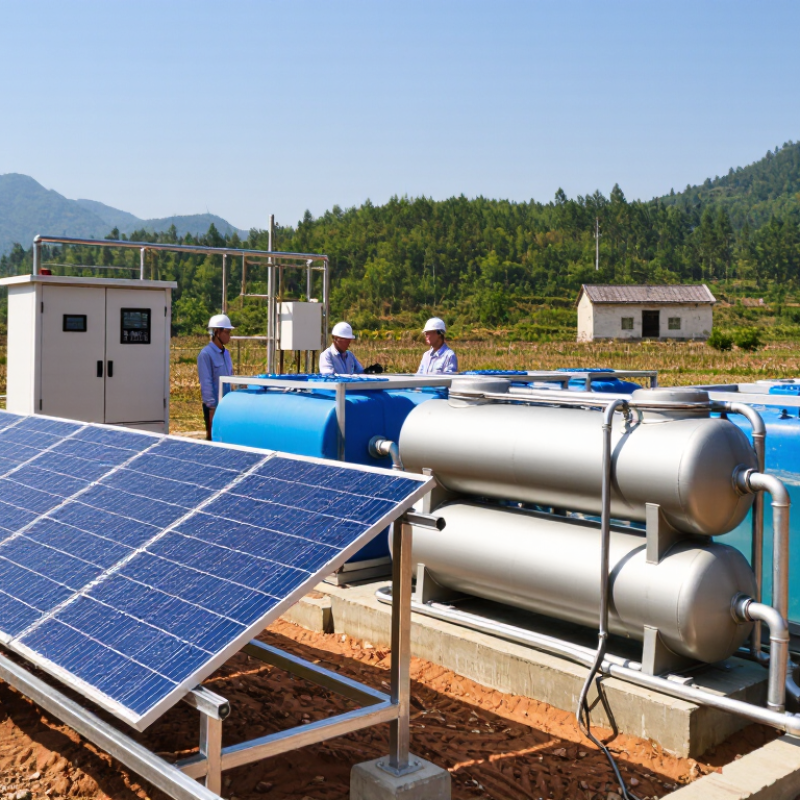
Photovoltaic panels can also power pumps, filters, or ultraviolet treatment units. A pump may push water through sediment and carbon filters before disinfection. UV treatment can inactivate many microorganisms when the water is clear and receives an adequate dose. These systems need components matched to the water source; a muddy stream, for example, may require pretreatment to reduce cloudiness. Clouds change the pace.

Performance depends on sunlight, maintenance, and careful handling after treatment. A solar still may produce little water on a cool, overcast day, and some volatile contaminants can carry over with the vapor. Filter cartridges also need timely replacement. Collection tanks and taps must stay clean, or treated water can become contaminated again. Simple field tests and periodic professional testing help confirm whether the system suits its intended use. One detail is easy to miss: purification is only as reliable as the storage.

Criteria for Selecting Chinese Solar Water Purification Suppliers

When comparing solar water purification suppliers in China, look beyond catalog capacity. Ask how the system performs with your actual source water, including turbidity, salinity, and seasonal variation. Small details matter. A reliable supplier should explain pretreatment needs, daily output under weaker sunlight, and how performance changes during cloudy periods. Request test reports that identify the water tested and the measurement method.

Review manufacturing controls, component specifications, and inspection records. Ask whether pumps, membranes, and solar panels are checked before shipment, and how defects are handled. Clear documentation is more useful than broad claims. Check whether the supplier can provide installation drawings, operating instructions, and spare-parts lists in a language your team can use. Also confirm training and after-sales response times in writing.

A sample test or pilot installation can reveal issues that brochures miss, such as sediment buildup or difficult cleaning access. Compare warranty terms and expected maintenance costs, not just the purchase price. Not every checklist is perfect; local water conditions can change the result. Keep that uncertainty visible, and ask suppliers to state their assumptions rather than promise a fixed output everywhere.

Top 10 Solar Water Purification Suppliers in China - Criteria for Selecting Chinese Solar Water Purification Suppliers

A practical comparison checklist for assessing suppliers. The rows below describe selection criteria and applicable evidence; they do not rank or identify individual companies.

No. Selection criterion What to verify Useful evidence or reference Why it matters
1 Water-treatment process and feed-water suitability Confirm the proposed process—such as filtration, reverse osmosis, or disinfection—and the feed-water limits for salinity, turbidity, and relevant contaminants. Process-flow diagram, feed-water specifications, and a written design basis for the intended source water. Solar power does not determine which treatment process is appropriate; the process must match the source water and required output.
2 Finished-water quality testing Check that the supplier defines target water-quality parameters and provides test results from a qualified laboratory for the proposed system. Test reports identifying the sample, test methods, date, and measured parameters. Compare results with the applicable local drinking-water requirements. Performance should be assessed using measured water quality, not general claims such as “pure” or “safe.”
3 Applicable product and material standards Verify the exact product, component, and scope covered by any cited certification or standard. For relevant reverse-osmosis drinking-water systems, check whether NSF/ANSI 58 applies. NSF/ANSI/CAN 61 addresses health-effects requirements for drinking-water system components and materials; it is not a general treatment-performance rating. Standards have defined scopes. A certificate for one component or model does not automatically cover an entire system.
4 Solar and electrical-component documentation Review specifications for PV modules, inverters, charge controllers, batteries, and electrical protection included in the system. Check relevant PV-module documentation, including IEC 61215 for design qualification and type approval and IEC 61730 for module safety, where applicable. Request model-specific test documentation. Electrical and PV components need suitable ratings and installation protection for the site and operating conditions.
5 Capacity and energy-use calculations Ask for expected daily output under stated sunlight, feed-water, and operating assumptions, plus the system’s energy demand. Design calculations showing operating hours, solar-resource assumptions, storage assumptions, and output at the specified feed-water conditions. Rated capacity alone does not show how much water a system will produce at a particular location or season.
6 Performance testing and acceptance criteria Agree on measurable commissioning tests, including flow rate, treated-water quality, and operating conditions. A written factory or site acceptance-test plan with measurement methods, tolerances, sampling procedures, and pass/fail criteria. Documented acceptance criteria make supplier claims testable and help prevent disputes after installation.
7 Durability and environmental suitability Assess the specified operating-temperature range, enclosure protection, corrosion resistance, and suitability for dust, humidity, or coastal exposure. Component datasheets, enclosure ratings where applicable, materials lists, and maintenance instructions for the intended environment. Site conditions can affect equipment life, maintenance frequency, and system availability.
8 Maintenance, consumables, and spare parts Confirm replacement intervals and availability for filters, membranes, lamps, batteries, and other consumables used in the offered design. Maintenance schedule, parts list, recommended inventory, and written information on supply lead times and warranty coverage. Operating costs and downtime depend on routine servicing and access to compatible replacement parts.
9 Manufacturing and quality-management controls Review the supplier’s production controls, inspection records, traceability, and process for handling nonconforming products. Audit information and a valid quality-management certificate, such as ISO 9001, if claimed. Verify the certificate’s issuer, validity, and scope. A quality-management certificate concerns management systems; it does not by itself certify water-treatment performance.
10 Export, installation, and after-sales support Clarify project responsibilities, documentation language, installation support, training, warranty terms, and response arrangements. Written scope of supply, installation and commissioning plan, operating manuals, warranty terms, and service-contact process. Clear responsibilities and support arrangements are important for safe commissioning and sustained operation after delivery.

Profiles of 10 Solar Water Purification Suppliers in China

WHO and UNICEF estimated that 2.2 billion people lacked safely managed drinking water in 2022 (JMP, 2023). IRENA recorded approximately 346 GW of new solar photovoltaic capacity that year (Renewable Capacity Statistics 2024). These figures indicate need and energy growth, not treatment performance. China-based supplier profiles vary by system and service focus. PV-powered reverse-osmosis integrators target saline water and often specify output by daily capacity. Solar-still fabricators offer simple evaporation-based units, usually for modest volumes. Membrane suppliers provide filtration components and replacement elements. Pump-and-controller vendors match flow rates with changing sunlight. Containerized plant builders package treatment equipment for faster installation.

Off-grid community-system designers combine panels, storage, and treatment for village use. Brackish-water specialists tune pretreatment to local groundwater conditions. Mobile-unit builders make transportable systems for temporary water needs. Monitoring suppliers add sensors for flow, pressure, or water quality. Engineering and service contractors handle installation, operator training, and maintenance. Field details matter. A polished specification may still omit cleaning frequency or spare-part lead times. Ask suppliers for test conditions, verified output, and maintenance records. Then compare performance against the water source, not brochure figures alone.

China Solar Resource Benchmarks for Water Purification

Annual global horizontal irradiation thresholds across China’s solar-resource classes

The bars show approximate lower-bound thresholds: Class I is at least 1,750 kWh/m²/year, Class II starts at 1,400, and Class III starts at 1,050. These are regional solar-resource benchmarks, not supplier-specific performance figures; actual purification output depends on system design, weather, and operating conditions.

Products and Technologies Offered by the Suppliers

Chinese solar-water-purification suppliers offer systems that pair photovoltaic panels with reverse osmosis, ultrafiltration, or ultraviolet disinfection. Some also supply solar thermal stills, which evaporate and condense water without high-pressure membranes. Product packages may include sediment filters, pumps, storage tanks, and control cabinets.

WHO and UNICEF’s Joint Monitoring Programme estimated that 2.2 billion people lacked safely managed drinking water in 2022. That figure underscores the need for treatment systems designed around local water quality, not just advertised output.

Energy options vary. Suppliers may combine direct solar power with batteries or grid backup to keep pumps running through cloudy periods. IRENA’s Renewable Power Generation Costs in 2022 reported an 89% decline in the global weighted-average cost of utility-scale solar PV electricity from 2010 to 2022. This trend supports solar-powered treatment, but it does not guarantee low operating costs at every site.

Not every site fits. Buyers should compare daily water production, membrane replacement intervals, and performance with local feedwater. Ask for test results and service plans. A compact unit can look convincing on paper, yet salty or turbid source water may require extra pretreatment. That trade-off deserves closer attention.

Applications and Service Capabilities of Chinese Suppliers

Top 10 Solar Water Purification Suppliers in China

Chinese suppliers serve projects ranging from village drinking-water points to farms and remote facilities. Their systems may combine solar panels with sediment filters, activated carbon, ultrafiltration, or reverse osmosis. The right setup depends on the source water. A coastal well with high salinity needs different treatment from a river with seasonal sediment. Small details matter.

Many suppliers provide more than equipment. Services can include water testing, system sizing, panel and battery configuration, installation guidance, and operator training. Some offer remote monitoring, helping teams track flow, pressure, and filter life. Buyers should ask for a clear daily output estimate under local sunlight conditions, not just a peak-capacity figure. Cloudy weeks change performance.

Maintenance support can determine whether a system remains useful after installation. Check spare-part availability, cleaning requirements, warranty terms, and response times before ordering. Request test data relevant to the intended water source, and confirm the treated water meets applicable local drinking-water standards. Not every site is simple. Even a well-designed unit can underperform when pretreatment is overlooked or operators lack practical training. A written service plan helps, though it cannot replace field checks.

Optimized by Optimole