How to Choose the Best Utility Blower Fan for Your Needs?
Choosing the right Utility Blower Fan can be a daunting task. With so many options available, it’s crucial to understand your specific needs. Industry expert, John Doe, emphasizes, “The right utility blower fan can change your project from tedious to efficient.” This highlights the importance of making an informed choice.
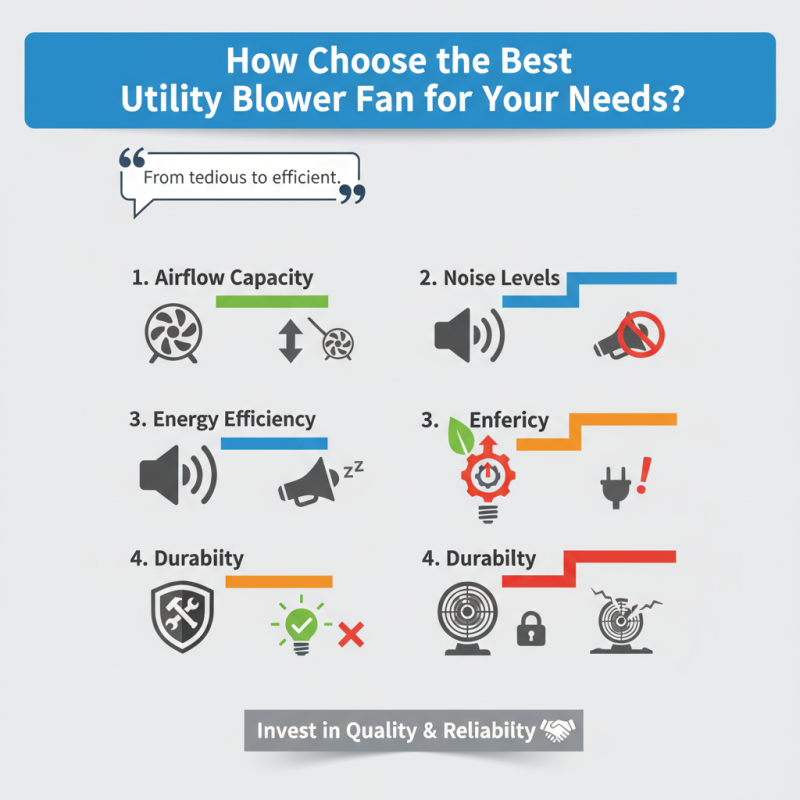
When selecting a Utility Blower Fan, consider factors like airflow capacity, noise levels, and energy efficiency. A fan with high airflow may be powerful, but if it’s too loud, it can disrupt your work environment. Reflect on your priorities and the settings where you'll use the fan. Different situations may require distinct features.
Many users overlook the importance of durability. A well-constructed fan will last longer, serving you better over time. However, it’s tempting to choose the cheapest option. Often, this can lead to regret. Investing in quality may seem expensive, but it pays off when the fan withstands wear and tear. Weigh your choices carefully, and aim for reliability.
Understanding the Different Types of Utility Blower Fans Available
When choosing a utility blower fan, understanding the different types is crucial. Commonly, there are three main types: centrifugal, axial, and mixed-flow fans. Centrifugal fans are effective for high-pressure applications. They excel at moving air in tight spaces. Axial fans are better for larger areas and high volumes of airflow. They are commonly used for ventilation. Mixed-flow fans combine features of both and provide versatility.
Consider where you will use the fan. If your space is small and requires concentrated airflow, a centrifugal fan may be your best bet. Sometimes a larger area needs more airflow without high pressure. An axial fan will excel in such scenarios. Also, think about the fan's noise level. If quiet operation matters, be prepared for compromises.
Tips: Always check airflow ratings before purchasing. Higher CFM (Cubic Feet per Minute) means more airflow. Assess the size of your space to match the fan's capacity. Ensure the fan's design aligns with your specific needs. Evaluate maintenance requirements; some models are easier to clean than others. In the end, identifying your primary requirements and re-evaluating your choices can lead to a more satisfying purchase.
How to Choose the Best Utility Blower Fan for Your Needs?
| Type of Utility Blower Fan | Power Source | Airflow (CFM) | Weight (lbs) | Noise Level (dB) | Ideal Uses |
| Axial Blower Fan | Electric | 2000 CFM | 15 | 75 | Construction Sites, Large Area Drying |
| Centrifugal Blower Fan | Gas | 1500 CFM | 20 | 82 | Heavy Duty Cleaning, Ventilation |
| Blower Fan with Adjustable Speed | Electric | 1000-2500 CFM | 10 | 68 | Indoor Use, Drying Small Areas |
| High-Velocity Blower Fan | Electric | 3000 CFM | 18 | 77 | Emergency Flooding, Quick Drying |
Key Features to Consider When Choosing a Utility Blower Fan
When choosing a utility blower fan, consider essential features that will meet your specific needs. Think about the airflow rate, measured in cubic feet per minute (CFM). A higher CFM means more air movement. For large areas, look for fans with a robust airflow. For smaller spaces, a moderate CFM may suffice. Also, check the fan speed settings. Multiple speeds can give you flexibility for different tasks.
Weight and portability are also crucial. A lightweight fan is easier to move. Consider a design with handles or wheels for added convenience. Durability matters, too. Look for materials that withstand various conditions, especially for outdoor use. Lastly, pay attention to noise levels. Some models operate quietly, while others can be quite loud. Depending on your environment, this could influence your choice significantly. Make sure to evaluate your space and needs before making a decision.
Assessing Power and Airflow Capacity for Your Specific Needs
Choosing the right utility blower fan can be challenging. Focus on power and airflow capacity tailored to your specific needs. Assess your environment first. Do you need it for a workshop, garage, or outdoor use? The area size determines the required airflow.
Consider CFM, which stands for cubic feet per minute. It measures airflow volume. Higher CFM numbers indicate more air moved. For small spaces, fans with lower CFM are adequate. Larger areas demand fans with higher CFM ratings. A fan that’s too powerful may cause unwanted noise and drafts.
Tips: Remember to think about the fan’s weight and portability. Heavier fans may be stable but harder to move. Lightweight models are easier to relocate. Check the decibel ratings too; quieter fans can make a big difference.
Don’t overlook the speed settings. Multiple speeds allow flexibility for different tasks. Some jobs need high speed, while others require a gentle breeze. It’s essential to evaluate these features against your tasks. A fan that seems perfect might not fit every situation. Make adjustments based on your experiences to find the ideal balance.
Evaluating Noise Levels and Portability of Blower Fans
When selecting a blower fan, noise levels and portability are critical factors. Noise is crucial, especially if you operate in a residential area. Many blower fans produce noise exceeding 70 decibels, which can disrupt daily routines. According to industry studies, fans rated below 60 decibels are preferable for quieter environments, making them suitable for indoor use.
Portability influences how easily a fan can be moved and used across different locations. Lightweight models can weigh under 10 pounds, making them easy to carry. However, more powerful units may be bulkier. A balance must be struck between power and ease of transport. The fan's design can also affect portability; models with built-in handles or wheels are often easier to maneuver.
Investing time in evaluating your needs is essential. Consider where you will use the fan most frequently. Will it be indoors or outdoors? What space size will it serve? Different blower fans cater to various needs, and understanding these requirements will help you make an informed choice.
Utility Blower Fan Noise Levels and Portability Comparison
Budget Considerations: Finding the Best Value Utility Blower Fan
When choosing a utility blower fan, budget considerations play a significant role. It’s essential to determine how much you can spend without compromising quality. A well-built blower fan can result in significant savings over time. Investing in a reliable model may reduce replacement costs later.
Look for features that fit your needs rather than only focusing on the price tag. Some fans offer adjustable speed settings, enhancing versatility. Others come with various nozzle attachments, making them more effective for specific tasks. A fan with a sturdy motor might cost more upfront but may last longer and perform better.
Many users find themselves prioritizing cost over quality. This can lead to dissatisfaction after purchase. It’s wise to read reviews and check product specifications carefully. Sometimes, a slightly pricier option may provide better durability and performance. Balancing your budget with functionality is critical to finding the best value utility blower fan.