
7 Best Robot Teleoperation Data Collection Providers?
Robot Teleoperation Data Collection is becoming a practical way to teach robots tasks that are difficult to capture through simulation alone. A remote operator guides a physical robot through a real workspace: a gripper closes around a cup, a wrist camera shifts, and the system records actions alongside sensor data. These demonstrations can help train models for manipulation and recovery. But the quality of the dataset depends on more than the number of recorded hours. Operator skill, consistent labeling, equipment reliability, and clear task definitions all matter.
The broader robotics market is expanding. The International Federation of Robotics reported 541,302 industrial robot installations worldwide in 2023, in its World Robotics 2024 report. That figure is not a measure of teleoperation demand. It does show why more teams are asking how robots can move from controlled trials into varied production settings. Robotics researcher Ken Goldberg has expressed the human-centered view this way: “Robots are not going to replace humans; they are going to make them more productive.” For data buyers, that makes operator experience and feedback loops worth examining—not just quoted collection rates.
This guide compares seven Robot Teleoperation Data Collection providers through practical questions: Can they capture synchronized video and robot-state data? Can they support different robot platforms? How do they handle quality checks, privacy, and dataset delivery? Small differences matter. A dropped frame or inconsistent label can turn a promising demonstration into weak training data. Provider claims also deserve verification; a polished sample is not proof of performance at scale. The comparison is a starting point, not a substitute for a pilot using your own tasks.
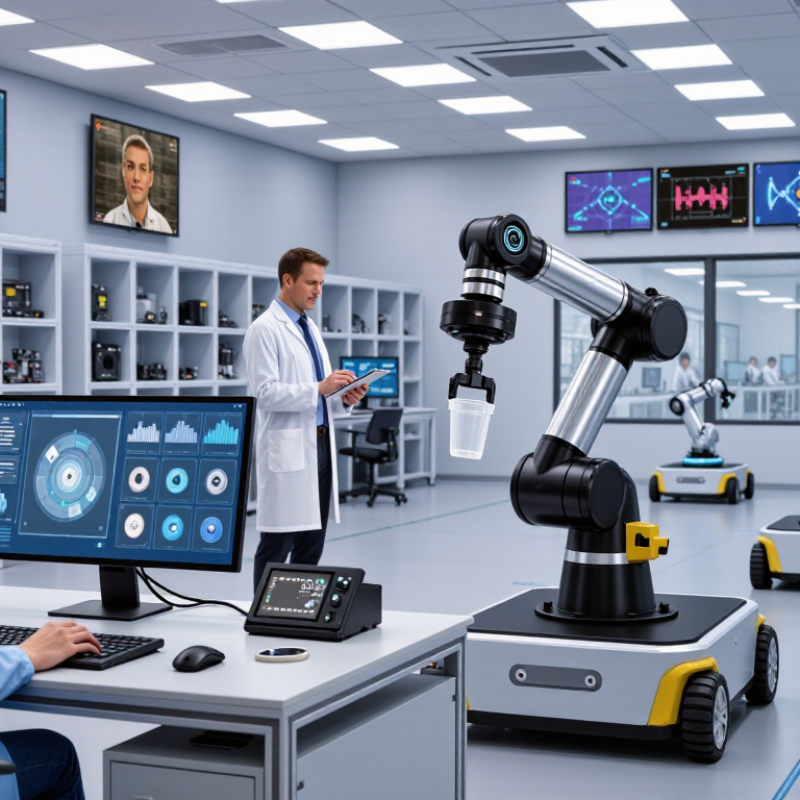
Robot Teleoperation Data Collection: Methods and Applications
Robot teleoperation data collection turns human demonstrations into training examples for robots.
An operator guides a robot arm or mobile platform through a live camera feed, using a joystick, hand controller, or motion-tracking glove. Each method records different details: joint positions, gripper state, camera images, force readings, and task timing. Reliable datasets synchronize these streams and mark key events, such as grasping a cup or placing a part on a shelf. Small errors matter. A two-frame delay can make a delicate insertion look like a control failure.
Applications range from warehouse picking and machine tending to household assistance and laboratory handling. For example, repeated demonstrations of picking soft packages can teach a robot to adjust its grip instead of squeezing too hard. Collection teams should test varied objects, lighting, and operator skill levels, then review failed attempts rather than quietly discarding them. That takes longer. It also exposes gaps that clean demonstrations hide.
When comparing data collection providers, examine their safety procedures, annotation checks, sensor synchronization, and ability to deliver task-specific recordings. Teleoperation is not a shortcut to general intelligence; demonstrations can encode human habits, awkward pauses, and inconsistent force. Some imperfections are useful, but they need careful labeling and validation before model training.
Key Criteria for Evaluating Data Collection Providers
Choosing a robot teleoperation data provider starts with the task, not the sales demo. Ask whether operators can record the motions your robot needs, including pauses, failed grasps, and recovery attempts. A drawer-opening task should capture handle contact, wrist angle, force changes, and the moment the drawer sticks. Useful providers explain how these details are recorded and checked. Small details matter.
Assess data quality beyond the number of clips. Look for consistent timestamps, synchronized camera and robot signals, clear task labels, and documented checks for missing or corrupted files. Ask how operators are trained and how disagreements in labeling are resolved. A large dataset can still be difficult to use if each session follows a different procedure. A polished dashboard can hide that problem.
Compare collection conditions with your intended deployment. Different lighting, object positions, operator styles, and robot configurations can reveal whether the data is varied enough. Request sample records and inspect a few sessions yourself; don’t rely only on summary metrics. Also clarify data ownership, permitted uses, retention periods, and access controls before collection begins. No scorecard is perfect. In practice, a small pilot often exposes overlooked issues, such as camera glare or inconsistent reset steps. Those findings may change which provider is the best fit.
7 Best Robot Teleoperation Data Collection Providers? - Key Criteria for Evaluating Data Collection Providers
The rows below describe seven common provider profiles, not named companies or verified vendor rankings. Capabilities vary by project and robot; confirm them directly before selection.
| Provider Profile | Best Fit | Typical Collection Modes | Data & Outputs to Confirm | Key Strength | Main Trade-off | Evaluation Checks |
|---|---|---|---|---|---|---|
| 1. Specialist Teleoperation Data Service | Teams that need real-robot demonstrations for manipulation or other hands-on tasks. | Human-operated robot demonstrations; collection can be conducted on-site or remotely, depending on the setup. | Confirm availability of synchronized observations, actions, timestamps, task labels, and failure annotations. | Can focus operations and annotation on the target task and robot configuration. | Collection throughput depends on robot availability, task reset time, operator skill, and safety procedures. | Request a representative sample, episode acceptance rules, task-reset plan, and data-rights terms. |
| 2. Managed Operator Workforce | Programs that need to collect many demonstrations across shifts, locations, or repeated task setups. | Scheduled human teleoperation, operator training, and supervised collection campaigns. | Check operator-level metadata, consistent task instructions, quality-review records, and coverage of edge cases. | Workforce operations can help expand collection beyond a small research team. | Operator onboarding, consistency, and ongoing quality control require active management. | Ask how operators are trained, how performance is measured, and how low-quality or unsafe episodes are handled. |
| 3. Robot Platform or Hardware Ecosystem Provider | Teams already using a supported robot platform and seeking an integrated collection workflow. | Teleoperation through platform-specific interfaces; the available workflow depends on compatible hardware and software. | Verify robot-state logs, camera streams, command formats, calibration records, and export options. | Integration with a supported robot can reduce setup and connectivity work. | Compatibility may be limited to particular hardware, control interfaces, or software versions. | Test the exact robot model, sensors, firmware, control latency, and access to raw data before committing. |
| 4. Teleoperation Software Provider | Organizations that have robots and operators but need tools for remote control and recording. | Remote or local teleoperation with software-based session recording; supported control modes vary. | Confirm raw video and action export, timestamp alignment, recording reliability, and APIs or file formats. | A software layer may fit into an existing robotics stack without outsourcing all collection operations. | Customers may remain responsible for robot deployment, operators, task design, and data QA. | Measure end-to-end latency and dropped-recording rates in the intended network and deployment environment. |
| 5. Simulation-and-Real-Data Provider | Teams that want to combine simulated task coverage with real-robot demonstrations. | Simulated demonstrations and, where available, real teleoperated episodes for validation or fine-tuning. | Check whether simulated and real data are clearly distinguished and whether coordinate systems and schemas are documented. | Simulation can support repeatable scenario generation; real-robot data captures physical effects that simulation may not represent. | Simulated data may not fully match real-world contact, sensing, or dynamics. | Request real-versus-sim provenance, validation results on the target robot, and a plan for measuring the sim-to-real gap. |
| 6. Data Capture and Annotation Operations Provider | Projects where sensor coverage, structured labeling, or dataset management are major requirements. | Robot-session capture paired with task labeling, review, and dataset organization. | Confirm sensor synchronization, label definitions, annotation provenance, privacy handling, and versioned exports. | Structured review and metadata can make collected episodes easier to search, audit, and reuse. | Annotation scope and review effort can add time and cost; labels are only useful when definitions are consistent. | Inspect the data schema, annotation handbook, reviewer workflow, and sample agreement between annotators. |
| 7. Custom Enterprise or In-House Collection Partner | Organizations with specialized robots, strict security needs, or task environments that are difficult to standardize. | Custom on-site or private-environment teleoperation and recording, designed around project requirements. | Define ownership, retention, access controls, export format, audit logs, and support for custom sensor streams. | Can be tailored to unusual workflows, deployment constraints, and internal governance requirements. | Custom integration and operational setup may require more planning and engineering effort. | Run a paid pilot with agreed acceptance criteria, security review, delivery milestones, and a documented exit/export plan. |
Profiles of Seven Robot Teleoperation Data Collection Providers
Seven provider profiles reveal different strengths in robot teleoperation data collection. Specialist teleoperation studios capture precise hand movements, tool use, and recovery actions in controlled workcells. Robotics integrators collect data while tuning sensors and robot configurations. Human-in-the-loop data platforms coordinate operators and label each task. Simulation-to-real teams pair virtual trials with physical validation. Field-service operators record robots handling varied surfaces and lighting. University-affiliated labs often provide carefully documented experiments. Distributed contractor networks offer broad task coverage, though operator consistency can vary.
The International Federation of Robotics’ World Robotics 2024 report counted 4,281,585 industrial robots operating worldwide in 2023. That installed base signals a large automation ecosystem, but it does not measure teleoperation data demand directly. Buyers should ask each provider for task completion rates, camera and sensor specifications, annotation rules, and examples of failed attempts. Small details matter: a dropped grasp, a delayed joystick response, or an occluded camera view can explain why a robot failed.
Compare providers using the same pilot task. Request raw recordings, event timestamps, operator training procedures, and written policies for removing personal information. Check whether data represents different robot models, workspaces, and task difficulties. Results can look convincing while hiding narrow coverage. No profile is perfect. A university lab may document methods well but lack production volume; a contractor network may scale quickly but need tighter quality checks. Evidence beats polished claims.
Comparing Provider Capabilities, Platforms, and Data Outputs
A useful comparison starts with the teleoperation workflow, not a feature list. Check which robot forms, control devices, and network conditions each provider supports. Then test the actual interface: Can an operator pause safely, correct a grasp, and resume without losing task context? Measure latency during real movements, not only in a quiet demonstration. Test it live.
Platforms differ in how they capture human input. Look for synchronized video, robot states, control actions, timestamps, and task labels. Ask whether data can be exported in documented formats, and whether failed attempts remain traceable. A polished dashboard is not enough if teams cannot audit or reuse the recordings. One imperfect but important detail: label quality often depends on human review, which adds time and cost.
The International Federation of Robotics’ World Robotics 2024 report recorded more than 4.28 million industrial robots operating worldwide in 2023; Asia represented 70% of new installations. That scale makes regional network support and compatible hardware practical evaluation criteria, not minor extras. Compare providers using the same task, robot, and recording checklist. Check sample files before signing. A provider’s output may look complete while omitting the moments when an operator intervened; that gap can weaken later analysis. No single score captures every workflow, so keep a small set of test tasks and review the raw outputs yourself.
How to Choose a Provider for a Robotics Project
Choosing a robot teleoperation data provider starts with the task, not a sales deck. Define the motions your robot must learn, such as opening a stiff drawer or placing a cup on a narrow shelf. Ask how operators are trained, how actions are recorded, and whether the setup matches your robot’s cameras, controls, and workspace. Relevant hardware experience can reduce costly translation errors. Still, a hardware match does not guarantee useful data.
Review how the provider checks data quality. Can it flag missed grasps, camera occlusion, or inconsistent control inputs? Ask for sample clips and clear acceptance criteria before committing. A small pilot can reveal delays, awkward operator workflows, and gaps in task coverage. Check how data is stored, transferred, and documented, too. Some details may only surface after work begins; that is a reason to build review time into the schedule.
Tips: Test before scaling. Use a few varied tasks, not one polished demo. Compare recordings against measurable goals, and leave room to revise your requirements. A provider’s confidence is useful, but evidence matters more.