
7 Best Parking Locks for Cars in 2026?

A car can disappear from a crowded lot, a quiet driveway, or the curb outside a familiar shop. The risk is real, but the numbers need context. The National Insurance Crime Bureau reported 1,020,729 vehicle thefts in the United States in 2023, about 1% more than in 2022. That figure describes reported thefts nationwide; it does not show where each theft occurred or prove that a particular device would have stopped it.

A Parking Lock adds a visible physical barrier, usually across a wheel or at the vehicle’s parking space. Its value depends on practical details: how firmly it anchors, how quickly it deploys, whether it fits the vehicle, and how it handles rain, grit, and repeated use. NHTSA’s vehicle-theft prevention guidance also emphasizes layered precautions, rather than relying on one measure alone. A lock can be one layer. It is not a guarantee.

This guide compares seven parking locks for cars in 2026, focusing on construction, fit, installation, visibility, and everyday convenience. We also consider owner feedback and manufacturer specifications, while treating performance claims cautiously. Some products look reassuring in a photograph but may be awkward to lift or secure in a narrow space. Small details matter. No comparison can replace checking the lock against your vehicle, parking surface, and routine. The data establishes a reason to take prevention seriously; it cannot rank products by itself.
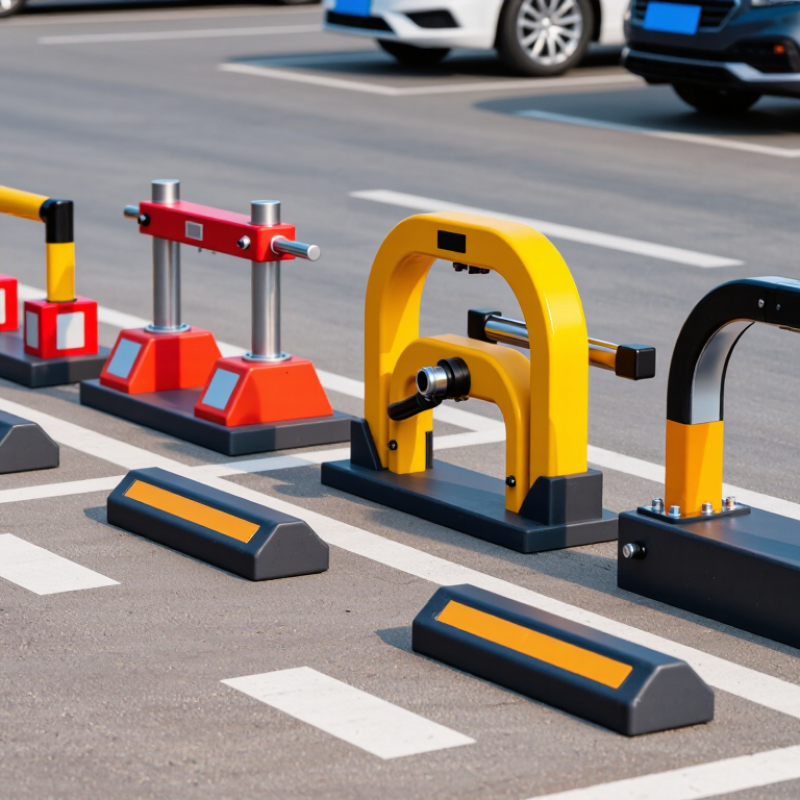
7 Best Parking Locks for Cars in 2026?

Parking Locks Explained: Manual, Automatic, and Retractable Designs

Parking locks differ less by appearance than by how much effort they ask from the driver. A manual lock is raised and lowered by hand, often with a key or simple locking mechanism. It has fewer moving parts, which can make upkeep straightforward. But in rain, darkness, or a tight parking space, bending down to operate it can become a nuisance. Check the hinge, lock cylinder, and ground anchors regularly; a stiff mechanism may be ignored when people are in a hurry.

Automatic locks use a remote or access control to raise and lower a barrier. They are convenient when a driver wants to stay in the vehicle. Power is the trade-off. Confirm how the unit behaves during a battery failure, and whether its controls are protected from splashing water and dust. A remote is not magic. It can be misplaced, and signal range varies by site.

Retractable designs fold or sink closer to the ground when not in use, reducing obstruction for walking or vehicle clearance. They may suit shared driveways, though installation and drainage need careful attention. Leaves and grit can collect around moving parts. Measure the vehicle’s lowest clearance, not just its tires. The best choice is the one drivers will use consistently, even if it looks less impressive. I would still inspect it after installation; real conditions often expose details a product sheet misses.

How to Evaluate the 7 Best Car Parking Locks for 2026

How to Evaluate the 7 Best Car Parking Locks for 2026

A useful comparison starts with the space itself. Measure the parking bay, check the surface, and note how close the lock sits to your car’s bumper. A raised arm should be visible to a driver, yet leave enough room for tires and nearby pedestrians. Small differences matter. Compare each model’s folded height and operating clearance, not just its advertised strength.

Look at construction, mounting, and daily use together. A steel body may resist impact, but its coating and exposed joints also need to handle rain, grit, and winter conditions. Check whether installation requires drilling and whether the mounting surface suits the supplied anchors. For powered locks, compare battery access, charging needs, and how operation works during a power or signal failure. Manual models avoid charging, though lifting an arm in the rain can become tiresome.

Test the details that product photos tend to hide. Can you see the lock clearly at dusk? Does the arm move smoothly, or catch after repeated use? Read warranty terms and independent owner feedback, while treating dramatic security claims cautiously. I would not trust a polished finish alone. No parking lock can prevent every collision or attempt at tampering, and a poorly positioned unit may create a hazard. A short, careful site check can reveal flaws that a ranking cannot.

Compare Locking Mechanisms, Anchors, Materials, and Obstacle Sensors

A parking lock is only as dependable as its weakest connection. Compare folding, telescoping, and fixed-post designs by how they resist prying, cutting, and vehicle impact. A visible red arm may deter casual entry, but a thin hinge can become the failure point. Check steel thickness, weld quality, corrosion protection, and whether exposed fasteners can be removed from outside. Small details matter.

Anchoring deserves equal attention. A strong lock mounted to weak concrete can loosen under repeated force. For a slab installation, follow the manufacturer’s specified anchor type, embedment depth, and concrete condition; do not assume ordinary paving blocks will hold. The National Insurance Crime Bureau reported 1,020,729 U.S. vehicle thefts in 2023. That figure is a useful reminder of risk, not proof that any parking lock prevents theft.

Obstacle sensors add convenience, but they are not a guard. Check whether the unit detects a bumper, bicycle, or low object near the arm, and whether it stops during lowering. Rain, dirt, and poor alignment can affect sensor performance. Test it with the actual vehicle and parking position. A sensor that beeps late is still a problem. Look for clear maintenance instructions and a manual override for power failures; otherwise, a flat battery can turn a security device into an obstacle.

Check IEC 60529 Ratings: IP67 Means Dust-Tight and 1 m for 30 Minutes

7 Best Parking Locks for Cars in 2026?
Check IEC 60529 Ratings: IP67 Means Dust-Tight and 1 m for 30 Minutes

When choosing a parking lock, check what its IP rating actually covers. Under IEC 60529, the first digit in IP67 means dust-tight protection. The second indicates resistance to temporary immersion in water up to 1 metre for 30 minutes, under specified test conditions. That is useful for outdoor equipment exposed to rain or brief flooding. It is not a promise that every unit will stay dry in every situation.

Look beyond the number. Ask whether the rating applies to the complete assembled lock, including its battery compartment, seams, and cable entries. IP67 does not automatically mean protection from powerful water jets, saltwater, or long-term submersion. Installation matters, too: a damaged seal or loose cover can undermine protection. I once assumed a high rating meant less maintenance; that was too simple. Dirt and wear still deserve attention.

Tips: Inspect seals and covers for cracks before wet weather. Keep drainage areas clear, and follow the maker’s cleaning guidance. If water has entered the housing, stop relying on the rating alone and have the unit checked.

7 Best Parking Locks for Cars in 2026? Check IEC 60529 Ratings

Use the IP code to compare ingress protection, not as an overall quality score. In IP67, “6” means dust-tight and “7” indicates temporary immersion in water up to 1 metre for 30 minutes. IP68 immersion conditions are specified by the manufacturer. These are rating examples, not product rankings.

Choose by Parking Surface, Vehicle Clearance, Installation, and Cost

A parking lock should fit the site as well as the car. NICB’s 2023 Hot Spots report recorded 1,020,729 vehicle thefts nationwide, a reminder that a visible barrier can add friction, but cannot guarantee security. On sound concrete, a fixed or folding post can provide a stable obstacle. Asphalt may need purpose-designed anchors; loose gravel is a poor base for many fixed models. Check the manufacturer’s surface requirements before buying.

Measure the lowest bumper or underbody point, not just the vehicle’s listed ground clearance. A raised post can scrape a low front lip, especially on a sloped driveway. Compare the lock’s footprint with your parking space, too. Installation matters: drilling into a slab takes tools and care, while a portable lock avoids permanent work but needs storage. Include installation, batteries, and likely repairs in the total cost. A cheap lock that stays unused is not much of a bargain.

Tips: Test the lock with your car parked in its usual position. Check clearance from several angles. Before drilling, confirm slab depth and check for buried services. One overlooked detail: rainwater and grit can make moving parts stick. A quick maintenance check helps.

7 Best Parking Locks for Cars in 2026? — Choose by Parking Surface, Vehicle Clearance, Installation, and Cost

A practical comparison of common parking-lock types. Dimensions and purchase prices are approximate ranges; specifications vary by model. Prices are typical USD estimates and exclude tax and, where applicable, professional installation.

Parking-lock type Best for Suitable parking surface Vehicle clearance to check Typical installation Approx. purchase cost Main advantages and limitations
Manual folding U-bar A reserved home or small-business parking bay Concrete or sound asphalt that accepts mechanical anchors Raised bar is commonly about 12–20 in. (30–50 cm); confirm tire path and underbody clearance when folded Bolt down with masonry or pavement anchors; requires drilling $25–$90 Simple and usually low-cost; must be raised and locked by hand, and anchor strength depends on the surface.
Manual folding parking post Driveways where a visible deterrent is preferred Concrete or stable asphalt suitable for anchored mounting Post is often about 18–28 in. (45–70 cm) upright; check its folded profile against the vehicle’s lowest point Surface-bolted base; some models need a clear folding area $30–$120 Easy to see and operate; occupies a small footprint, but still requires manual use and secure anchoring.
Remote-controlled electric barrier Frequent access to a private parking space Level concrete or firm pavement; check drainage and the maker’s mounting requirements Arm or barrier height commonly ranges around 12–20 in. (30–50 cm); confirm folded clearance and vehicle approach angle Anchor to the surface; battery-powered units avoid wiring, while wired units need a suitable power supply $100–$350 Convenient remote operation; batteries need maintenance, and electronics may be affected by weather or impact.
Solar-assisted automatic barrier Outdoor spaces where regular charging or wiring is inconvenient Firm, level pavement with adequate sunlight for the solar panel Often similar to other compact barriers: roughly 12–20 in. (30–50 cm) raised; verify folded height for low vehicles Anchor the unit and position its panel for sun; installation typically avoids a mains-power connection $150–$450 Can reduce routine charging; performance depends on sunlight, battery condition, and weather exposure.
Ground-recessed retractable bollard A cleaner-looking installation with the bollard lowered when not needed Best suited to sites where excavation and proper drainage are feasible Raised bollards are commonly about 20–32 in. (50–80 cm); when lowered, check that the cover is flush and safe to drive over Requires excavation, a ground sleeve or housing, and attention to drainage; professional installation is often appropriate $100–$400 for the unit; installation is additional Retracts out of the way, but installation is more involved and water or debris can affect the mechanism.
Removable bollard with ground socket Occasional access changes or a space that needs a removable barrier Concrete or pavement where a socket can be securely installed; not loose gravel alone Above-ground height is often about 24–36 in. (60–90 cm); remove the post fully before driving over the socket cover Install a ground socket, often requiring drilling or excavation; the bollard is lifted out when access is needed $80–$250 No folding mechanism to maintain; requires storage for the removed post and a properly fitted socket cover.
Portable wheel clamp Temporary protection when drilling or permanent installation is not allowed Most firm, level surfaces; fit and stability depend on the clamp design and tire No fixed ground-mounted height; check tire-size compatibility, wheel access, and clearance around the vehicle No ground installation; fit and lock around a compatible wheel each time the vehicle is parked $25–$100 Portable and suitable for rented spaces; slower to use and does not reserve an empty parking space by itself.

Before buying, measure the vehicle’s lowest ground clearance and approach angle, verify the parking surface and anchor requirements, and check local rules for drilling or installing barriers in shared spaces.

Optimized by Optimole